Defining Sustainable Agriculture – in Cuba
Apr 12 2010
By Elizabeth Ü
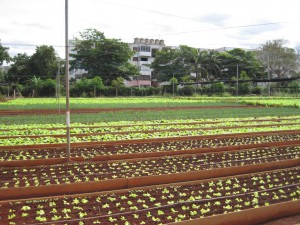 In February, I visited urban farms and gardens in Havana, Cuba, a country often showcased as a model of “sustainable agriculture.” More recently, I attended the Agriculture 2.0 “sustainable agriculture” investing conference in Silicon Valley, CA. Both experiences got me thinking about what does – or does not – earn the right to be labeled by this often-used, vaguely-defined term.
How do you define “sustainable agriculture”? The terms organic, biodynamic, and Fair Trade have clear definitions, but does any one of these certifications (or combination thereof) constitute “sustainability” in agriculture? Does it matter how the farm, company, or cooperative entity is organized and managed? Does feeding people who are hungry constitute sustainable agriculture? Does the type of food matter? Who grew the food, processed it, distributed it, sold it? Under what working conditions? How far has the food traveled from farm to fork? How much (of what?) is enough? Where do you draw the line?
Here are a few of the contradictions I’m still struggling to reconcile with regard to what I saw and heard in Cuba. While my process of inquiry was similar during the Agriculture 2.0 conference – can one really define in-vitro meat as sustainable? what about open-ocean aquaculture? – I will cover my reactions to that event in more detail in a future post.
I visited Cuba along with my fellow Food & Society Fellows. Our hosts, professors from the University of Havana, highlighted various facts and figures related to their country’s agricultural system, both in the classroom and during visits to several urban farms and commercial gardens right in Havana.
We frantically scribbled our notes, amazed at what we were hearing about Cuba’s food system: every month, an agronomist visits all the urban farms and gardens in a region, noting which pests or problems seem to be most frequent, and then there’s a conference to support the growers in learning how to most effectively address those issues. Each school in Havana has a farm in charge of producing their fruits and vegetables, about eight pounds per student per month.
Sustainable agriculture. Check.
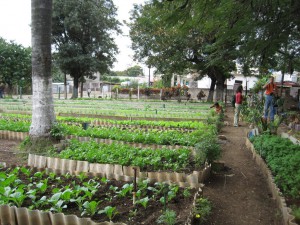 I mentioned this last piece to one of our translators, excitedly explaining that it’s been a real challenge to connect farms and schools in the U.S., much less deliver that volume of vegetables directly from a specific farm to a school’s kitchen. She looked at me, confused. “They don’t eat vegetables in the school lunches here,” she told me. “What do the kids eat?” I asked. “Rice…” “And beans?” “Maybe beans,” she said, shrugging her shoulders.
Let’s assume that both parties were relating information that was true, based on their own (different) experiences. Maybe not ALL schools are directly connected to specific farms. Maybe not all children in Havana are getting eight pounds of fruits and vegetables through their school lunches every month.
Maybe it’s not sustainable after all.
More “facts” I jotted in my notebook: urban farmers have higher incomes than doctors. Fruits and vegetables generally travel less than 30 miles from the place they are grown to where they are sold.
Ah ha! Sounds sustainable.
One evening we ran into another group of Americans in our hotel lobby. Surprisingly, this delegation was also there representing agricultural interests… but from what we could gather, it appeared that they were in Cuba to sell agricultural products. It was certainly a revelation to me that ANY products from the U.S. could be sold in Cuba. In fact, we heard from several sources that Cuba, a country regaled for its local food system, imports roughly 75-85% of its food. The majority of imports are from the U.S., including rice, wheat, soy, chicken, pork, and apples. When we inquired, both at the university and in the field, we were unable to get any clear answers as to whether or not there were attempts underway to reduce Cuba’s dependence on foreign imports.
The plot thickens.
So most of the fruits and vegetables in Cuba are local and organic – or so we heard, so we believe. But I couldn’t shake the knowledge that farmers in Cuba don’t use pesticides, herbicides, fungicides, or chemical fertilizers in part because the U.S. won’t allow U.S. companies to sell these products in Cuba. The farmers we visited told us that they would use at least some of these products, particularly fertilizers, if they were available. (Nitrogen sources are scarce, and we saw few farm animals – which produce fertilizer in the form of manure – during our visits). And across the board, everyone who met with us expressed hope that the U.S. embargo prohibiting exports to Cuba – or at least, the majority of exports – would be lifted.
How can I ever gather enough information to determine if something is sustainable or not?
Ultimately, I believe that my desire to define something as “sustainable” or “not sustainable” is a red herring. Sustainability is not a label that can be earned once and for all. Rather, it is a journey that a person, a farmer, a company, a country must take constant steps toward, assuming that is even the intention in the first place.
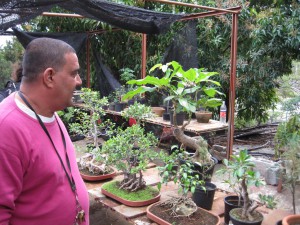 In my own journey, this trip to Cuba reminded me that even within a complicated picture, there are points of inspiration and hope: a long row of perfect bok choy, in the middle of Havana, tended carefully by worker-owners of that urban garden. An award-winning bonsai artist whose beloved, private collection of ornamental plants almost outnumbered his plants available for sale. A tiller fashioned out of a single old tire, weighed down by the driver of the oxen that pulled it along. Ultimately, these are the memories of Cuba I want to carry with me, each one contributing to my newly-expanded vision of what sustainable agriculture can be.
What are your definitions of sustainable agriculture? We welcome your comments!
Elizabeth Ü is Manager of Strategic Development at RSF Social Finance.
In February, I visited urban farms and gardens in Havana, Cuba, a country often showcased as a model of “sustainable agriculture.” More recently, I attended the Agriculture 2.0 “sustainable agriculture” investing conference in Silicon Valley, CA. Both experiences got me thinking about what does – or does not – earn the right to be labeled by this often-used, vaguely-defined term…