This blog series breaks down each of the five principles that guide our work in regenerative finance. Let’s begin with Act from Abundance.
Today, the financial system is working exactly as intended. It prioritizes the wealth of the few over the health of the many. It’s a zero-sum game.
As it exclusively seeks higher and higher returns, traditional finance never acknowledges the harm those same returns reap on communities and the natural environment. It claims that endless growth brings benefits to everyone, without admitting that such growth left unchecked leads to unchecked ecological destruction.
Regenerative finance rejects this winner-take-all mentality. Instead, it offers that our planet has more than enough for individuals, communities, and the natural world to thrive in harmony.
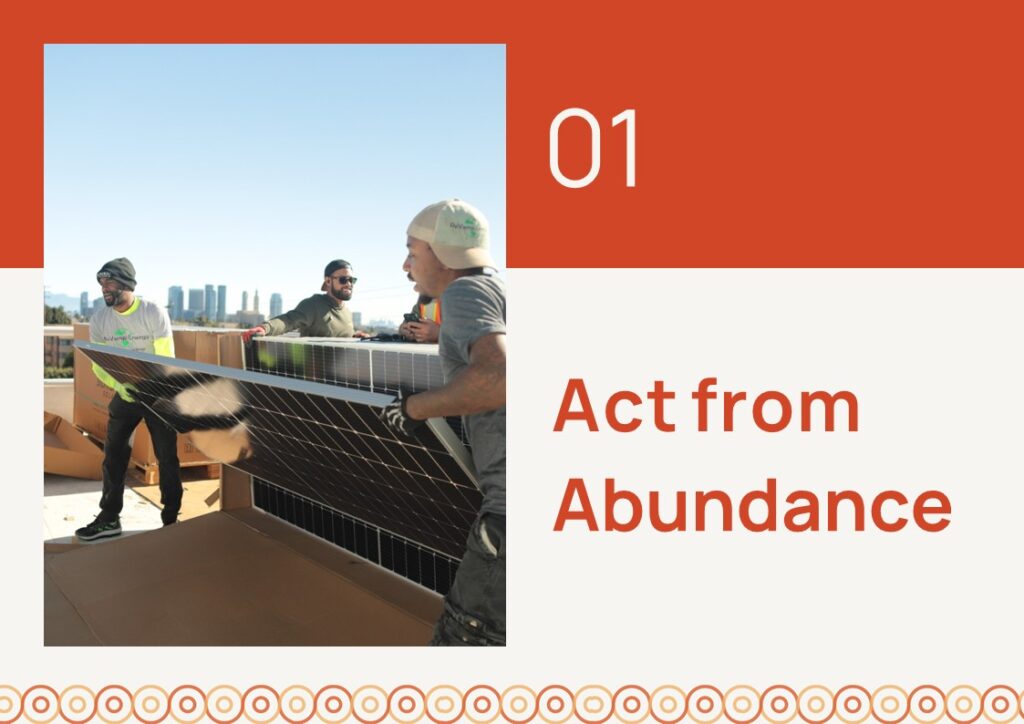
A clear example? Renewable energy. Instead of extracting power from finite, polluting resources like coal, oil, and natural gas, renewable energy providers tap into energy sources like wind and solar. Infusing these suppliers with affordable, accessible capital – regenerative finance, in practice – ensures that clean energy can power our communities, our economy, and our planet.

Sunwealth, an RSF partner based in Cambridge, Massachusetts, exemplifies what it means to act from abundance.
Sunwealth has pioneered a financing model that brings critical capital to the community-based solar market. Their solar projects – installed on rooftops, parking lots, and other underutilized spaces – deliver renewable energy and long-term savings to nonprofits, schools, municipalities, affordable housing authorities, small businesses, and low- to middle-income households. In short, they ensure the benefits of clean energy flow to those often left out of the transition.
Since they were founded in 2014, Sunwealth has generated over $161 million in revenue for local developers and installers, created 1,700+ solar jobs, delivered $115 million in savings to energy users, and reduced over 1.24 million metric tons of carbon. RSF has supported Sunwealth with multiple loans – including a recent one funding four projects expected to create $11 million in savings, nearly 120 new jobs, and avoid 85,000 metric tons of carbon emissions.

This infusion of regenerative finance, says Sunwealth CFO Omar Blayton, “enables Sunwealth to remain catalytic with its community impact. We look forward to collaborating with [RSF] for years to come.”
By investing in renewable sources of power, Sunwealth builds a business model with a “triple bottom line”: giving people a critical resource at a price point they could afford, preserving the planet’s finite resources, and ensuring that Sunwealth itself could earn enough to grow its business and expand its business. That’s abundance – and regenerative finance – in action.
Want to act from abundance in your own financial practice?