As we extend our values-aligned financing to more and more mission-driven businesses and nonprofits, we remain committed to the focus on relationships that allows us to work in true partnership. Growing our portfolio management team helps us maintain the hands-on support that has worked for RSF and our borrowers for 40+ years.
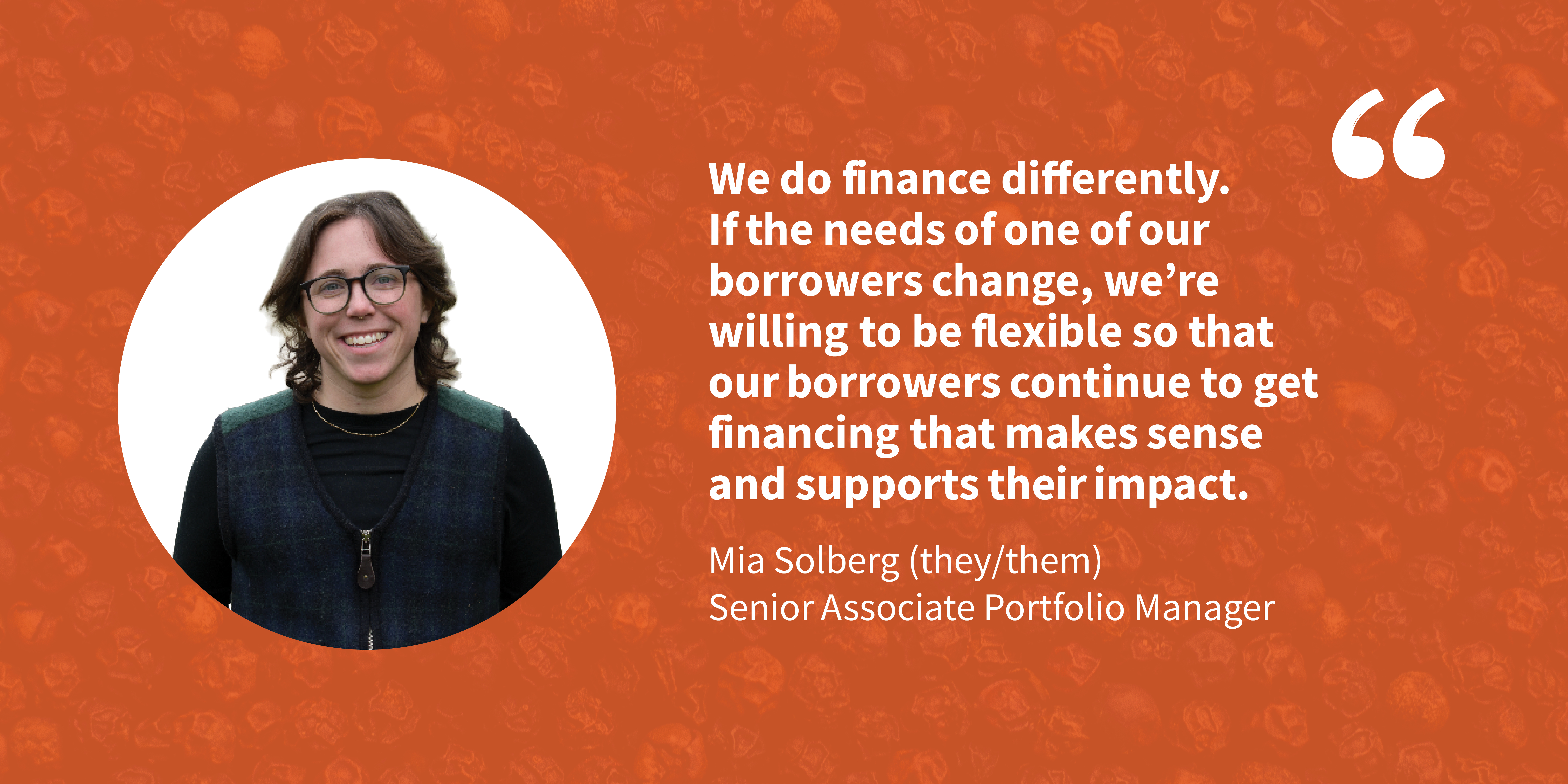
We recently sat down with Senior Associate Portfolio Manager Mia Solberg (they/them) to learn more about their approach to this role and what drives their work at RSF. This interview has been condensed from its original form.
What brought you to your role at RSF?
As an economics and business major and a feminist and gender studies minor, I bring a multidisciplinary lens to conversations in each field. Finance often uses restrictive language to exclude historically disadvantaged groups.
After college, I first worked as a private equity research analyst, where I learned how to speak the language of finance. My role at RSF allows me to translate that language to people and organizations who have long been underserved or overlooked by traditional finance, and to work with them as a trusted financial partner.
What are your main responsibilities as a portfolio manager?
I manage a portfolio of several dozen borrowers. On paper, my role is to manage RSF’s risk exposure by ensuring borrowers are in compliance and are able to repay their loans on time. But it’s really about guiding them through the life cycle of an RSF loan, and beyond it into their long-term success.
At RSF, we do this with care and collaboration, really understanding their model to make sure that RSF can remain flexible for the borrower and continue to offer the financial support they need.
How does RSF do finance differently?
One example is by offering smaller loan sizes than many other lenders. Banks around the world are doing less and less small business lending, because those loans are just as much work as larger ones, but bring in less money. It’s called “the missing middle” of financing.
But those loans, and the businesses and nonprofits that use them, have so much potential for impact. We recognize this, and we’re willing to put in the effort to make those loans work at a price point our borrowers can afford.
Can you share one of your favorite borrower stories?
One of the borrowers in my portfolio is a sustainable, values based retreat center called The Guest House. They offer retreat space to other organizations committed to mindfulness, leadership, the arts, environmental education, and more. It’s a great organization, and their team is so communicative and proactive.
Since we first offered The Guest House a loan, we’ve had to make a few adjustments. For example, when they understandably had cancellations during the COVID-19 pandemic, we adjusted the terms of their loan to account for their unplanned loss in revenue until things evened out.
I think that speaks to how we do finance differently. If the needs of one of our borrowers change, we’re willing to be flexible so that our borrowers continue to get financing that makes sense and supports their impact.
What’s something that surprises people about RSF?
That you can invest with as little as $1,000! Many other impact investors have minimum investments of $50,000 or more. RSF is accessible to a lot more people who want to contribute to a better economy.
This interview was adapted from RSF’s annual report. Read the full report here.