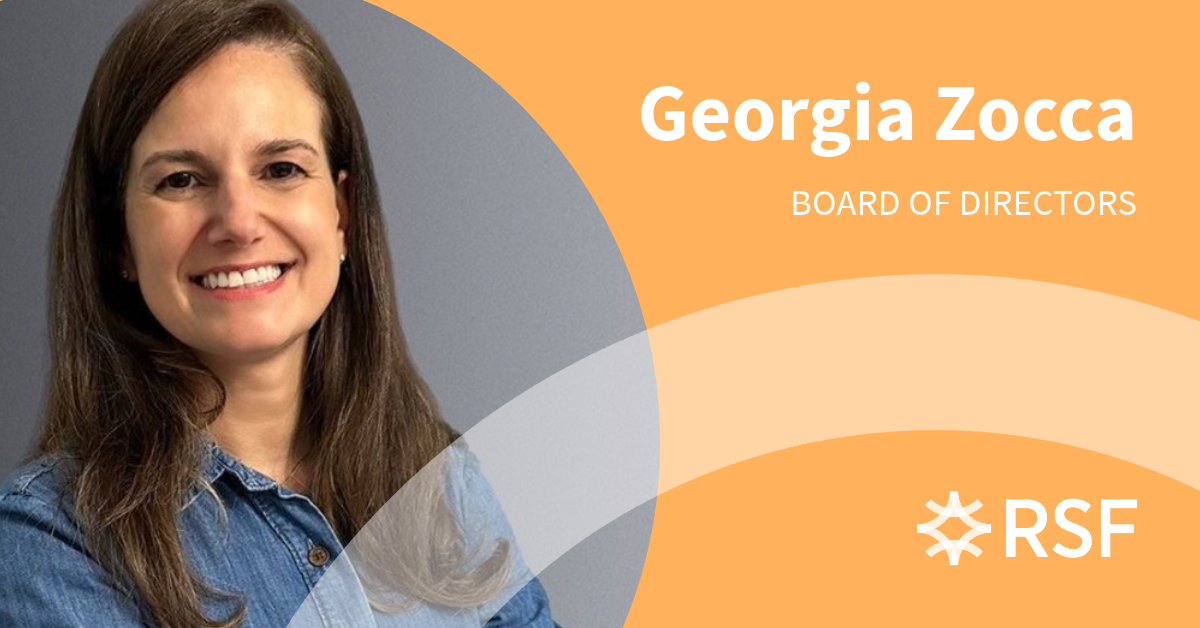
Earlier this year, RSF welcomed Georgia Zocca and Zachary Smith to our Board of Directors. We sat down with each of them to learn more about their experience in purpose-driven finance, their decision to join our board, and their vision for RSF.
Read on for a condensed version of our conversation with Georgia. Stay tuned for our interview with Zachary, which will come out later this year!
Can you tell me about your role at Do Good CFO?
I’m a fractional CFO with Do Good CFO, where I work with mission-driven organizations that include nonprofits, CDFIs, and foundations. My role is to give organizations that can’t yet justify a full-time CFO the same caliber of financial strategy and rigor that larger institutions have, all on a part-time, contract basis.
After 20 years in banking, I reached a point where I wanted my legacy to be something more than balance sheets. I wanted to use my skills to help the world prosper and be a better place. That’s what led me to fractional CFO work: taking the financial discipline I’d built at scale and putting it directly in service of mission-driven organizations.
What makes Do Good CFO a good fit for a business?
Mission-driven organizations often reach a stage where their financial needs outgrow what a bookkeeper or part-time controller can handle, but they aren’t yet ready for, or don’t need, a full-time CFO. Do Good CFO fits that gap precisely: it means an organization gets access to a CFO with 15-20+ years of experience of the same caliber of leadership a much larger institution would hire full-time, scaled to the hours that the work actually requires.
At many of my clients, I’m the first finance person the organization has ever had. This means the analysis I bring often leads to genuine “a-ha” moments: a runway that’s shorter than assumed, financial projections built under the wrong assumptions, or a credit-loss exposure nobody had modeled. I help organizations write the policies and build the guardrails that let them execute their strategy safely going forward, and I do that work in direct partnership with their top leadership.
Do Good CFO stresses the importance of strategic financial management. What is that, exactly? And how does it complement access to values-aligned finance, like what RSF provides?
Strategic financial management is the discipline of using an organization’s financial infrastructure – models, policies, reporting, and controls – to not just record what happened, but to support the organization’s strategy and inform what it should do next.
Well-intentioned firms with great missions can fail because they don’t pay enough attention to the numbers. Strategic financial management helps leaders answer questions around how much runway an organization has, what risks its balance sheet is exposed to, what it can responsibly commit to, and how it should raise or deploy capital.
That discipline is what makes values-aligned finance durable, rather than well-intentioned but fragile. RSF can offer capital that’s more patient, more relationship-based, and more aligned with an organization’s mission. But that capital still has to be repaid, and the borrowing organization still has to manage risk, liquidity, and growth responsibly to make good on it. Strategic financial management on the borrower’s side is what lets values-aligned capital actually do its job.
How did you decide to join RSF’s board?
I first heard about RSF from David Guendelman, the founder of Do Good CFO, when he mentioned the work Do Good CFO had done with RSF in the past. That led to an eventual introduction to RSF’s CEO Jasper van Brakel and Board chair Amir Kirkwood. What drew me to RSF is its vision that finance can be directed toward social and ecological wellbeing rather than just extracted for its own sake. I also admire RSF’s approach to lending, from the innovative ways it raises capital, to the transparent, relationship-based way it works with borrowers once that capital is deployed.
Across 20+ years at growing financial institutions in the United States and abroad, I’ve had firsthand experience navigating multiple economic cycles, including periods of rapid expansion, tightening credit conditions, and acute stress. I pair that experience with a practitioner’s view of CDFI and nonprofit finance from the borrower’s side. That view from both sides of the table, the lender’s and the borrower’s, is the perspective I hope I can bring to RSF’s board.
What is your vision for RSF?
I want to help RSF grow and scale safely. My vision is that RSF can extend values-aligned finance to many more organizations and communities: more reach, more capital deployed, and more borrowers served, without ever outrunning the financial and operational foundation that makes that capital trustworthy. I would like to help build that foundation as RSF grows.
Georgia Zocca is a fractional CFO at Do Good CFO, where she provides strategic finance support to mission-driven organizations, including CDFIs, impact investors, and foundations. She works directly with leadership teams on financial reporting, policy development, and long-term financial planning. Her focus is building the financial discipline and infrastructure these organizations need to grow responsibly and earn the trust of lenders, funders, and boards. Learn more about the work she supports on Do Good CFO’s website.